
After many decades of teaching how body image is represented through the technique of body tracing, one of the Authors developed a sequence of steps that informs the entire process of developing a finished body tracing with the aim of opening a dialogue, a process of discovery that triggers changes between the person and how we experience our body. It becomes a process about owning our body.
Within the potential space the body tracing occupies, a profound engagement with our sense of identity emerges, where the creative elaboration of the artwork contains and protects, while giving visibility and meaning to the unthought and the unknown as well as to the desired. Filling the image on the paper is a voyage from perception to symbolisation, searching for an aesthetic resonance that makes the body image come alive, encountering phases of disorder and chaos along the way.
The process becomes a transitional act, integrating what is felt and what is seen with what is understood, allowing a new body image to emerge. The physical experience of being drawn around (the body's interaction with the paper) merges with the body image (the result on the paper), allowing lived experience to be integrated with cognitive perceptions to a greater or lesser extent, according to the client's limits and defence mechanisms.
Methodology : exploring the content and meaning of each phase
Phase 1 : establishing body boundaries
By defining inside and outside, this phase expresses the dynamic process of “finding and forming” the self (Wright, 1991), as well as the quality of object relations and the type of attachment. In the primary stages of development as well as during particular moments of life, “ the experience of surfaces touching one another is a principal medium through which connections are made and organisation achieved” ( Ogden, pag. 50,1987)
Tracing one’s body re-enacts what happened to the child in her/his process of development, from a fragmentary perception of the body, to a sense of totality, shaped by a human social context in which the mother’s face plays a fundamental role ( Winnicott, 1971 ) and potentially creates a feeling of trust and acceptance towards our own body as well as towards the outside world ( see case study).Furthermore, by following the contour of each body part, the skin’ s functions are vitalised. According to Anzieu (1994), these areas wide reaching as containment, protection, inscription,maintenance, individuation, intersensoriality, sexualization and recharging.
The outline creates a container with variable characteristics. It may be visible, clear and continuous or fragile, weak and blurred,assuming the function of a safe place and a good enough mother (Winnicott, 1971) or showing difficulties and fears.
Phase 2 : modifying the body boundaries
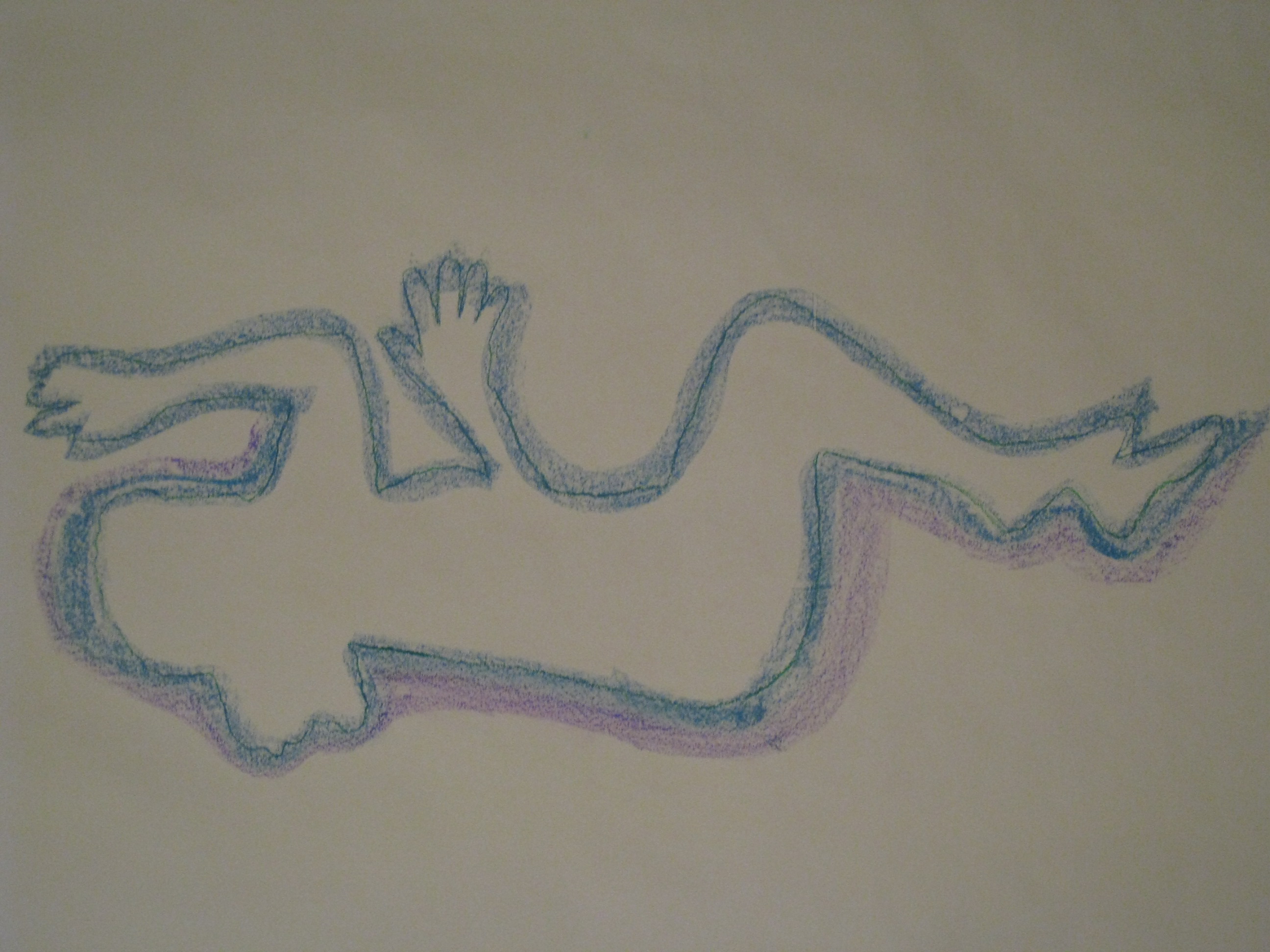
This phase helps to regain safety and control through different actions that may change the line, its colour, thickness, or by adding further lines, repairing missing parts or erasing disturbing marks. These actions work towards sustaining a sufficiently accepted and loved body image.As we can see in Photo 1, the woman has outlined her contours many times with different colours, in order to create a stronger protection for her body’s contents.
Phase 3 : painting and filling
The artwork comes alive through materials and techniques applied inside and outside the body outline, alternating processes of internalisation and externalisation. The three modalities of experience (Ogden, 1987, Della Cagnoletta, 2010, 2017, 2020) help us differentiate the creative processes:
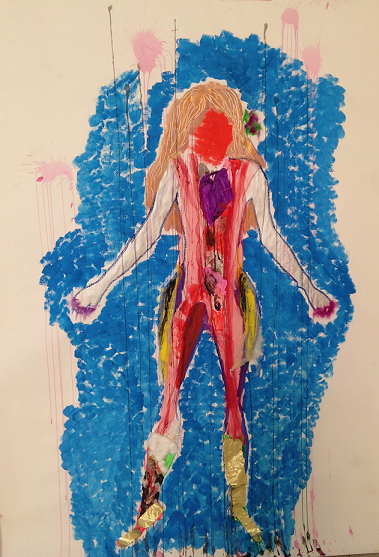
Body Concentration : sensory based experience (centred around tactile, visual, olfactory and acoustic perceptions that define the continuity and integrity of the body’s boundaries) In Photo 2, the art materials used have strong tactile elements and were applied directly with her hands, while the collage materials were chosen for their specific textures, void of any symbolic meaning.
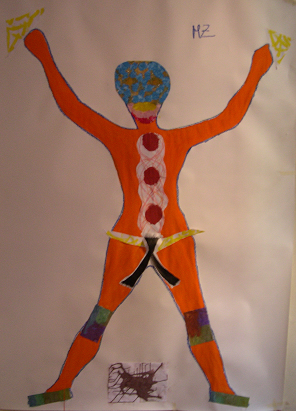
Formal Solution: spatial organisation (the need to order chaos, divide and separate through forms and colours). As we can see in Photo 3, the body has been painted using orderly and symmetric alforms, each color well separated from the other.
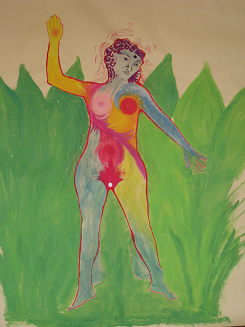
Symbolic Narration: creating meaning (a story is told, expressing desires and fears).Photo 4 narrates the story of a woman that comes out of a plant to carry a message to humanity, to live in peace with our environment.
These three modalities may all be present or one may dominate over the others, as our examples show.
Phase 4 : Dialogue and performance
Opening a dialogue with one’s body tracing may involve words, movements, dance or performance. Its goal is to engage the body with the world, connect inside and outside, activate flux in the field of forces that enable change.
Clinical Case: feet on the ground
(Photo 5)
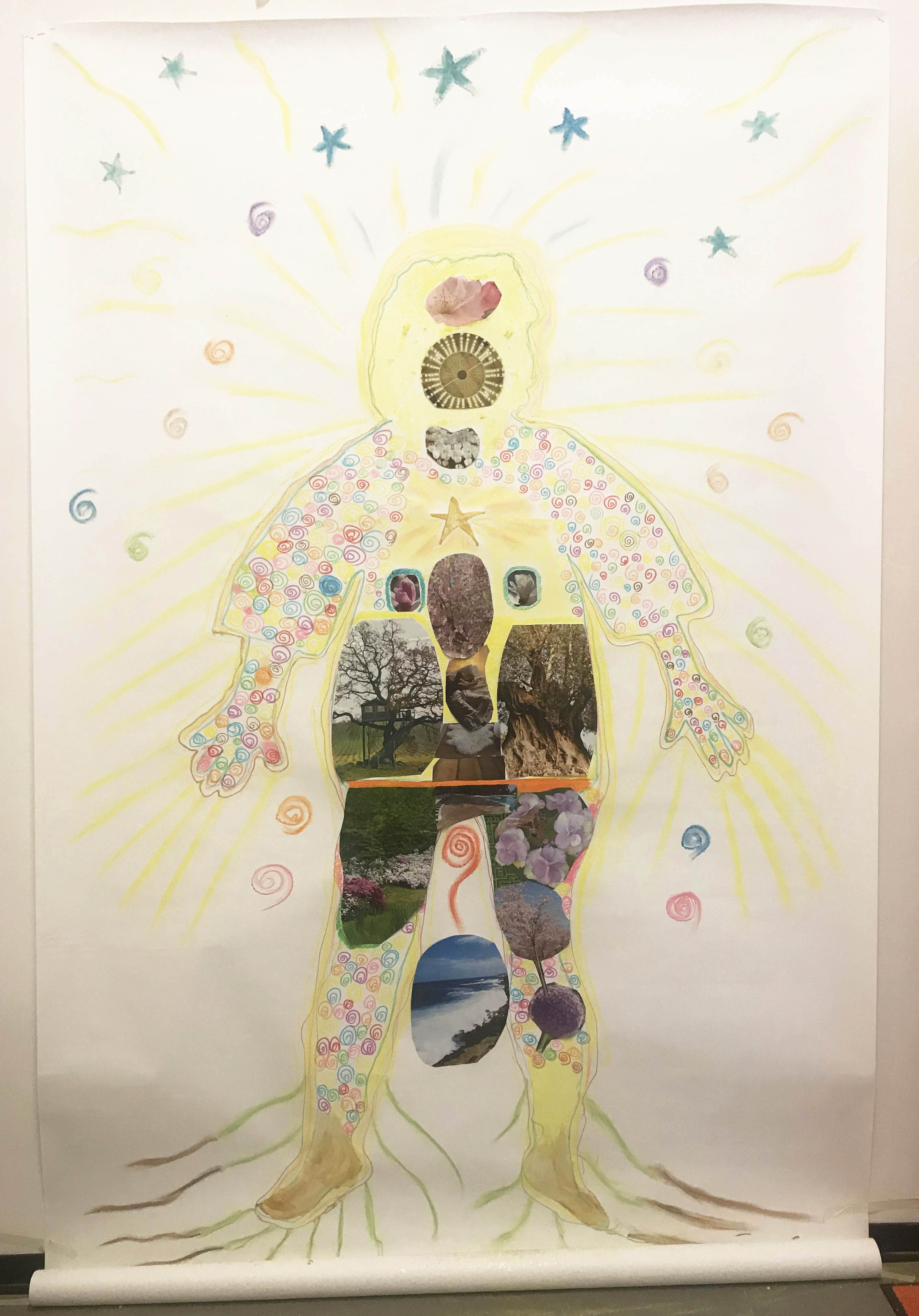
We would like to discuss the possibility of using body tracing as a tool to transform the body into something to think from rather than about (Farnell, 2000). This involves an important shift of perspective from viewing the body as an object in our possession to its becoming the means through which we perceive and interact with the world (Hetherington, 2020). This process has been discouraged by Western society: “I have a body, you are likely to say, if you speak of embodiment at all. Not, I am a body” (Mairs,1996). It is especially challenging for clients who have dissociated from their body and its physical sensations in order to protect themselves from past trauma. We will analyse here a case study that aims to demonstrate how important the process of reconnecting with our body is, and how the process of body tracing can provide a tool that crosses this bridge in a constructive and tolerable way.
Elena attended an art therapy group of twelve sessions. In her late fifties, medical trauma connected with her preterm birth complicated her relationship with her body. She describes her lived experience as teaching her that neither inside nor outside was safe. Hence, she escaped 'into a world in the sky' to use her words, or possibly a house in the trees, in reference to the image used within the body tracing. She was enthusiastic about the body tracing as a process to bring her body onto the ground. In fact, it was fundamentally important to her that it was hung on the wall in such a way that bottom of her feet exactly touched the point in which the wall met the floor.
Elena describes the body tracing as "challenging but useful: a means of transforming difficulties into strengths". She hung it on the wall in such a way that the bottom of her feet exactly touched the ground. This is important as she describes herself as "all sky". She has difficulty connecting with physical sensations within her body, while living in a world rich in images and visual metaphors. This has led to a general sense of invisibility that demanded attention as soon as the body's outline was made. Working as part of a group, there was an inevitable comparison between her image and the others'. Her outline in yellow pastel seemed all the fainter next to the other thick, painted outlines. "It was no surprise that it was fragile. Exactly how I perceive myself. Different from the others. Yet the body tracing transformed this obstacle into an opportunity. I invested a lot. And I saw how my body tracing become rich and full of energy. It was a great satisfaction to see its vulnerability become a resource in terms of delicacy and sensitivity. My envy of the others changed once the images were filled. In my eyes, mine is the most beautiful and the most visible. It shines."
Elena's body tracing created a safe place inside the body that could be externalised. The elements drawn outside the body act as extensions of the body itself. She says, "The world is our mirror, and by creating the garden I'd like inside of me, I hope to transform the outside too."
Conclusion
When the Authors approached Elena to ask about the possibility of writing about her body tracing she had ones lightly unusual condition, that her real name be used. She explained that her identification with the body tracingwas so strong that she didn’t want somebodyelse’s name/identity attached to it. The Authors are sharing this as a testimony to the power of the body tracing technique to create an artwork that not only represents ourselves but is experienced as embodying the self. We believe that this finds its roots in the 1st phase of production (the body’s physical involvement as a template). This is carriedt hrough the other phases as the developing image becomes more than just a reflecting mirror. In constant modification, a dialogue with the self develops. The body tracing’s creator merges with it as he/she works and then steps back to witness what he/she has created,. In this space, the artist/creator can question and the body tracing confirms and clarifies. We look forward to further research in this area that explores why body tracing is such a useful tool for connecting bottom up experiences of the body (sensory-perception) with a top down (symbolic) relationship with the body. The Authors are pleased to be contributing with another article that expands on this theme and is due to be published in spring 2021 as part of IJAT’s special edition on co-production.
REFERENCES
Anzieu,D. 1994, l’Io-pelle, Borla, Torino ( 1985, Le Moi-peau, Bordas, Paris )
Della Cagnoletta, M., 2010, Arte Terapia. La Prospettiva Psicodinamica. Roma: Carocci.
2017, Applicazioni dell’arteterapia: la tecnica del ‘body–tracing’ e l’immagine corporea. In Boccalon R. (cur.) La Cura dell'arte / l'arte della cura. Disponibile da http://www.aracne-rivista.it/Mimma%20Della%20Cagnoletta%20.pdf
2020, L’immagine corporea e il body tracing, in Semeraro,R. (Ed.) Colorati di Natura,Magenes-Kiwi Ed., Milano
Farnell, B., 2000,Getting out of the habitus: an alternative model of dynamically embodied social action, Journal of the Royal Anthropological Institute, 6 : 397-418
Hetherington, R., 2020,Invisible complicity in LGBTQI art therapy: A series of case studies in response to Hadley's call for the need for vigilance. The Arts in Psychotherapy 70, https://doi.org/10.1016/j.aip.2020.101667
Mairs, N. (1996). Carnal acts. Boston, MA: Beacon Press.
Ogden, T., 1987, The Primitive Edge of Experience, Aronson, New York
Winnicott, D.W., 1971, Playing and Reality, Tavistock, London
Wright, K., 1991, Vision and Separation, Free Association Books, London
Mimma Della Cagnoletta, a doctor of Philosophy, certified psychologist, art therapist, and psychoanalyst, is one of the co-founders of Art Therapy Italiana (1982), the association that developed the first art therapy training in Italy in collaboration with Arthur Robbins, Diane Waller, Andrea Gilroy, and many others. As a former professor at the University of Milan, she has been teaching and supervising for three decades. She is currently the director of advanced studies in art therapy for Art Therapy Italiana. She runs art therapy groups for service users and professionals in many health services and private institutions. She works with dance movement therapists to integrate art and movement into teaching and practice. She is in private practice in Milan, working with adults, and the author of an art therapy handbook and co-author of a book on group art therapy and many articles, both in Italian and English. She is a member of the editorial board of the journal “Creative Arts in Education and Therapy: Eastern and Western Perspectives”, a member of EFAT and Apiart.
Rivkah Hetherington is an HCPC (UK) registered art psychotherapist, trained at Art Therapy Italiana in Bologna (Italy) where she lives and works. She practices as an artist, (BA in Fine Art Winchester School of Art and MA, Wimbledon School of Art) in the UK). She has a private practice in Bologna with children and adults, individually and in groups. She has studied at the Institute for Sensorimotor Art Therapy and is currently involved in bringing ‘The Changing Room 11’ trauma-oriented project from the USA to Italy. She works in Bologna’s women’s prison as well as in projects with unaccompanied minors and vulnerable teenagers. In collaboration with Bologna’s LGBTI center, she set up the first art therapy group in Italy dedicated specifically to LGBTQI clients and has published her research in this field (The Arts in Psychotherapy). Her international identity is depicted in working with Third Culture Kids through International School. She is also a member of research groups in the fields of Adoption & Foster Care and Prison Work.