* Working at University of Pavia, Italy, hosted by LabTalento, University research laboratory about giftedness and high ability. Mensa - The High IQ Society member.
Abstract
The present work is a case study based on the author' research about the way gifted and high ability people communicate through the artistic medium.
The idea that distinctive neuroanatomical, bio-behavioral, genetic, socio-cultural, and environmental influences model their artistic communicative way sustains the research.
The project was hosted by the Italian University laboratory LabTalento, part of the Department of Brain and Behavioral Sciences of the University of Pavia, supporting and developing gifted and high ability people.
Art therapy workshops were held during the period from March to May, 2019 and during the summer, fully dedicated to certified gifted and high ability children.
The artworks analysis is performed by using a reading grid, developed on purpose, focusing on their structural elements combined with gifted and high ability’s cognitive and emotional mindset.
Introduction
Giftedness and High ability: a definition
Giftedness was mainly linked to the individual Intelligence quotient (IQ) (Terman, 1925). More and more clearly appeared the importance of other aspects contributing to the creation of the gifted personality. IQ index remains the most distinctive element to speak about giftedness.
Considering the Gaussian distribution of the population, the IQ average is included between 85 and 115; between 70 and 85 border people are included, under 70 there is intellectual disability . Beyond 120 high potential/ability people are located, above 130 we can talk of giftedness.
The 2 - 5% of the population can be considered gifted (picture 1).
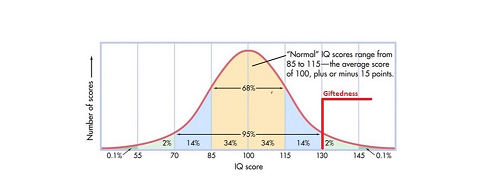 Pic. 1 IQ normal distribution curve
In 2011 Rena Subotnik described high IQ level as a precondition for giftedness (Subotnik R.F., Olszewski-Kubilius P. & Worrell F. C., 2011) confirming the importance of extending the area of investigation. Among the most frequently found gifted characteristics, although not necessarily shown, are (Sternberg, 1982; Howe, 1990; Jensen, 1980):
- Highly developed verbal skills
- Excellent mnestic skills
- Intense curiosity
- Multiplicity of interests
- Strong imagination and creativity
- Sense of humor
- Complex thought
- Concern and interest in social and metaphysical issues;
- Strong sensitivity
This implies a composite definition of giftedness, consisting of a mix of neuroanatomical, bio-behavioral, genetic, socio-cultural, family and environmental influences (Bloom, 1985; Sternberg, 2001; Subotnik et al., 2011).
Gifted and high ability children
The typical aspects of the gifted behaviour and personality are thoroughly analyzed when considering children into their educational environment.
If the above can show an overall psychological well-being, well-adapted in social life, high performing in school and in sports, it is important to notice how often myths and prejudices affect gifted people. Such as:
- Asynchronous development (Pfeiffer & Stocking, 2000; Silverman, 1993): a mismatch between cognitive, and emotional development describing quite advanced intellectual skills versus far below her age social ones. That might lead to social isolation or exclusion.
- Perfectionism on performance: “strong awareness of own expectations” (Cross, 1997). The need for continuous high performances and the fear of failure could cause stress, illness, underachievement.
- Vulnerability to other people’s judgment, with consequent feelings of inferiority and inadequacy (Pyrit, 2008) and high sensitivity to family and peers psycho-emotional environment (Neihart, 1999; Neihart et al., 2002):
- Intensity is strictly linked to overexcitability (or supersensitivity) (Dabrowski, 1967). Overexcitability means that gifted mindset needs lower stimulations to produce a response, while producing stronger and longer reactions.
Giftedness is usually investigated by the Wechsler scales, an IQ test designed to measure the performance capabilities in specific areas rather than amount of intelligence. The WISC test (Wechsler Intelligence Scale for Children) is dedicated to children from 6 to 16 years old (Wechsler, 2008).
Art therapy with gifted and high ability children
Research project
Analyzing the peculiarities of the cognitive-emotional functioning of gifted and high abiity’s children, we hypothesized that their artworks could show more typical elements (e.g. logical/consequential ones, logical/temporal, verbal and sign text), compared to the control group. This statement is sustained by the following comparison between gifted/high ability mindset and semiotic elements, on purpose designed (picture 2):
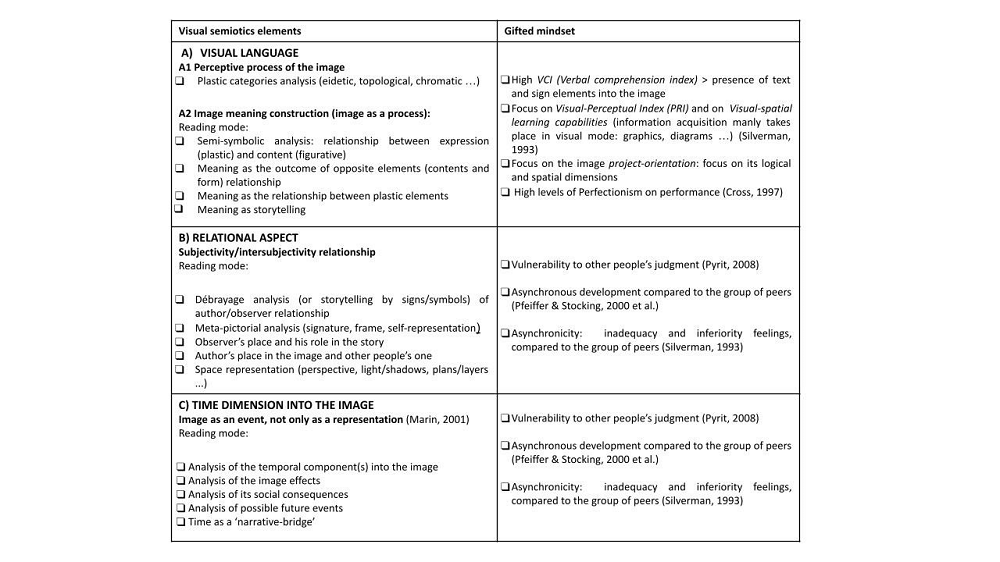
Pic. 2 Visual semiotic / Gifted mindset comparison
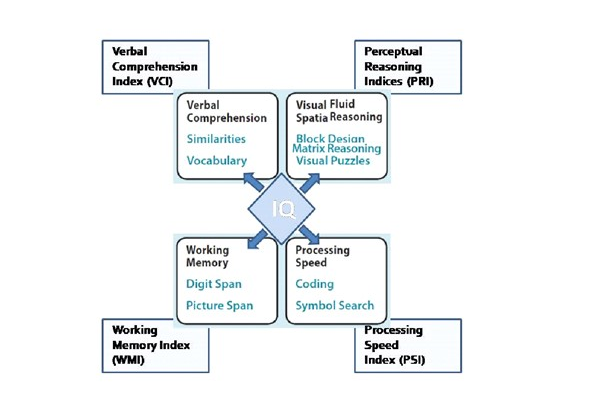
Distinctive topics of the present investigation are derived by WISC main intelligence domains (e.g. VCI: Verbal Comprehension Index). For a complete overview here are the primary index scales into the WISC test (picture 3):
Pic. 3 Intelligence primary index scales according to the Wechsler’s WISH
Verbal Comprehension Index measures the ability to listen to a question, draw upon learned information, reason through an answer and express thoughts aloud.
Perceptual Reasoning explores the ability to examine a problem, draw upon visual-motor and visual-spatial skills, create solutions and test them.
Working Memory assesses children's ability to memorize new information, hold it in short-term memory, concentrate and manipulate that information to produce reasoning processes.
Processing Speed assesses the abilities to focus attention and quickly scan, discriminate between, and sequentially order visual information.
Total IQ is the average of the different areas scores.
The gifted/high ability group
It is composed of 7 children - 5 males and 2 females - aged between 8 and 10. They joined the Art Therapy project hosted by LabTalento, an Italian University Laboratory.
To sustain the correlation between WISC scale investigated areas and the users’ images elements, here follow the scores of the participants tot IQ index.
Note that for children with the starred name it is possible to use only tot IQ because their evaluation was performed with WISC iii, which does not provide homogeneous data compared to WISC iv (picture 4).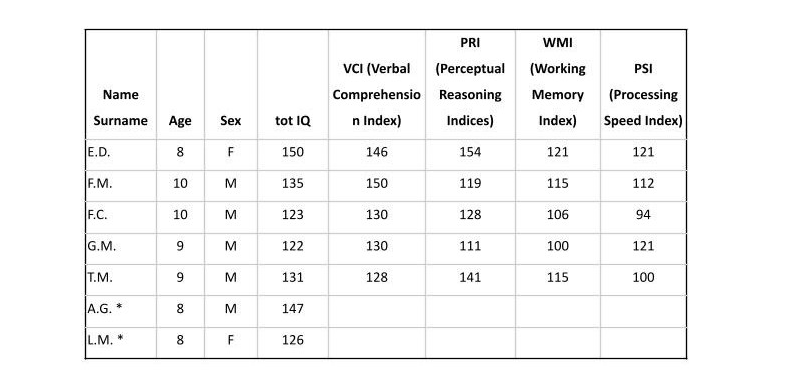
Pic. 4 Participants’ Tot IQ and Area Indices
The control group is represented by an Italian primary school class (5th grade) located in Milan, Italy, observed during a period of 10 laboratories from October to December 2018. This group is made up of 17 children aged 10 (7 female and 10 males).
Setting
Workshops took place every two weeks from March to May 2019, each meeting lasting about one hour. A bright room with movable desks and a big shelf to display materials plus an adjacent storage area and bathroom were dedicated to the project by the University.
Both classic artistic materials (tempera colors, markers, water-soluble wax pastels) and recycled one (fabrics, plastic and cardboard) were offered.
Setting characteristics (materials, tables disposition) were adapted according to the workshop specific theme.
Analyzed elements:
The main analyzed elements into the artworks are:
- Meta-painting aspects: Signature, Frame and Self-representation. Presence or not, positioning within the work, characteristics (size, technique, color, style, any relationships with compositional elements).
- Observer’s place and his role in the story. Positioning (e.g. high, low, in front of the work), attributed role (e.g. witness, mirror, depository of a relationship, not in relation), dynamic he/she activates: watching/not watching - not wanting to watch/not wanting to be watched.
- Time dimension into the image. Image as a narrative-bridge between historical past and future possibilities. (Image effects, Social consequences of the image, analysis of the temporal component in the image, possible future events)
Results
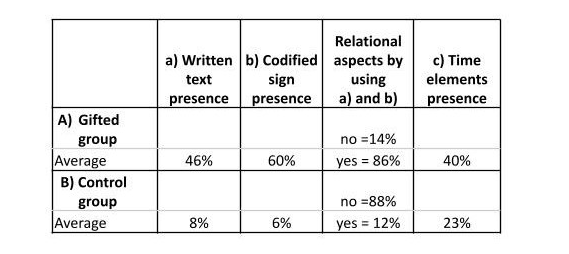
The analysis of the artworks shows the following main evidences (picture 5):
Pic. 5 Data comparison: LabTalento sample (A) vs control group (B)
To increase the number of the gifted sample, table A (LabTalento data) was flanked by the one coming from the “STIMA Summer camp workshop”.
Since the images produced during the STIMA Summer Camp are too few to constitute a sample of analysis, it was decided not to aggregate the data with the previous ones. It was preferred to use the on-off criterion identifying the presence/absence in the image of the following: written text, coded sign, time element etc. (picture 6)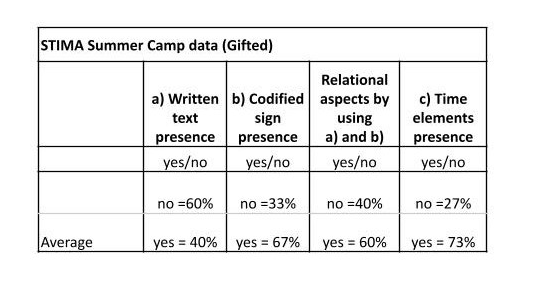
Pic. 6 Data collection: STIMA Summer Camp, July 2019
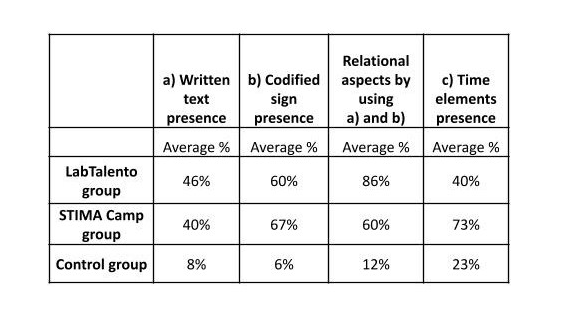
Note that the percentage presence of the analyzed elements into the STIMA Summer camp group is similar to the LabTalento group’s one (A).
Note that this sample gifted group shows a percentage of the analysed elements (written text, codified signs, relational aspects, time dimension) similar to the LabTalento sample. (picture 7)
Pic. 7 Data comparison of the three samples
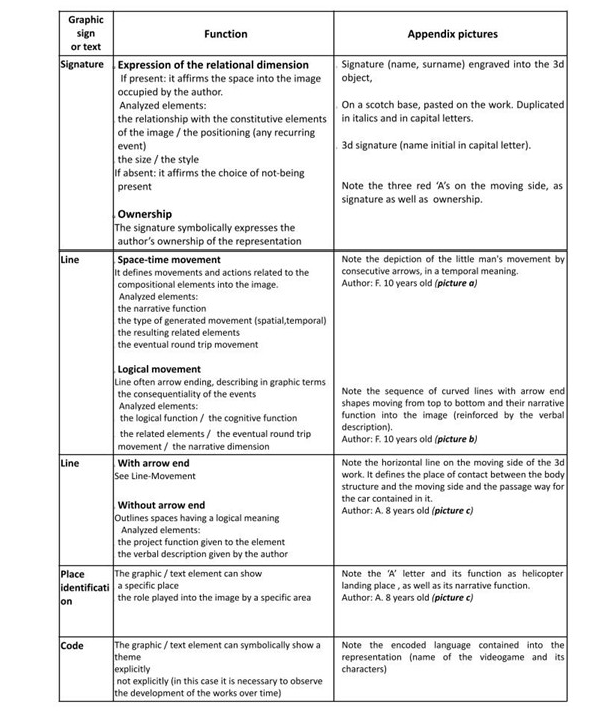
Special attention was given to point a) and b) into the images.
The following possible uses and purposes of literal and symbolic text into the artworks have been identified (picture 8):
Pic. 8 Uses and purposes of written text/signs
Conclusion
The artworks show the presence of a higher number compared to non-gifted users, of typical gifted-related elements; they are summarized into:
- graphic/literal translation of the task project into the image,
- the presence of written text/codified signs
- the simultaneous presence of multiple languages (graphic, verbal, logical-sequential)
It can lead to a possible correlation with the IQ Indices. In particular, it can be observed that PRI (Perceptual Reasoning Indices) and VCI (Verbal Comprehension Index) exceeding 140 can be predictors of an intense communicative use of graphic/literal translation of the task project into the image, as well as written text and coded sign.
The average value of 130 is a predictor of the presence of the aforementioned constituent elements into the image.
Bibliography
Bloom, B.J. (1985). Developing talent in young people. NY: Ballantine Books.
Cross, T.L. (1997). Psychological and social aspects of educating gifted students. Peabody Journal of Education, 72(3–4), 180–200.
Dabrowski, K. (1967). Personality shaping through positive disintegration. Boston, MA: Little, Brown.
Howe, M.J.A. (1990). The Origins of Exceptional Abilities. Oxford: Blackwell.
Jensen, A.R. (1980). Bias in Mental Testing. Free Press, New York.
Neihart, M. (1999). The impact of giftedness on psychological well‐being: What does the empirical literature say? Roeper Review, 22:1, 10-17, DOI: 10.1080/02783199909553991
Neihart, M. (2002). Gifted children and depression. In Neihart, M., Reis S., Robinson N. & Moon S. (Eds.), The social and emotional development of gifted children (pp. 93-103). Waco, TX: Prufrock Pres.
Pfeiffer, S., Stocking, B. (2000). Vulnerabilities of Academically Gifted Students. Special Services in the Schools. 16. 10.1300/J008v16n01_06.
Pyryt, M. (2008). The Dabrowskian lens: Implications for understanding gifted individuals. In Mendaglio, S., Dabrowski’s Theory of Positive Disintegration (pp. 157–173). Scottsdale, AZ: Great Potential Press
Preuss, L.J., Dubow, E.F. (2004). A comparison between intellectually gifted and typical children in their coping responses to a school and a peer stressor. Roeper Review, 26 (2), 105-111.
Silverman, L.K. (1993). The gifted individual. In Silverman, L.K., (1993). Counseling the gifted & talented (pp. 81-106). Denver, Co: Love Publishing.
Sternberg, R.J. (2001). Giftedness as developing expertise: A theory of the interface between high abilities and achieved excellence. High Ability Studies, 12, 159-179.
Subotnik, R.F., Olszewski-Kubilius, P. & Worrell, F.C. (2011). Rethinking giftedness and gifted education: A proposed direction forward based on psychological science. Psychological Science in the Public Interest, 12, 3-54
Terman, M.L. (1925). Mental and Physical Traits of a Thousand Gifted Children. Genetic Studies of Genius Volume 1. Stanford (CA): Stanford University Press
Wechsler, D. (2008). WAIS-IV: Wechsler Adult Intelligence Scale. San Antonio, TX: Pearson.
Appendix
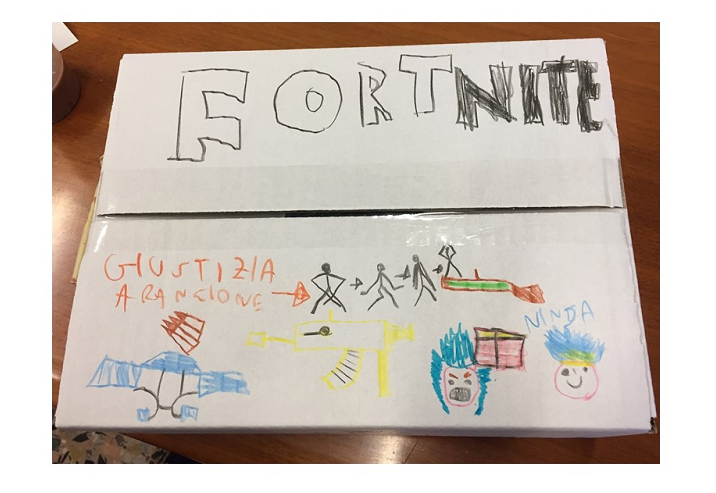
Picture a) Example of sign (→) describing a space-time movement and a narration.
Colored crayons on cardboard box (30x20x10 cm).
Author: F, 10 years old
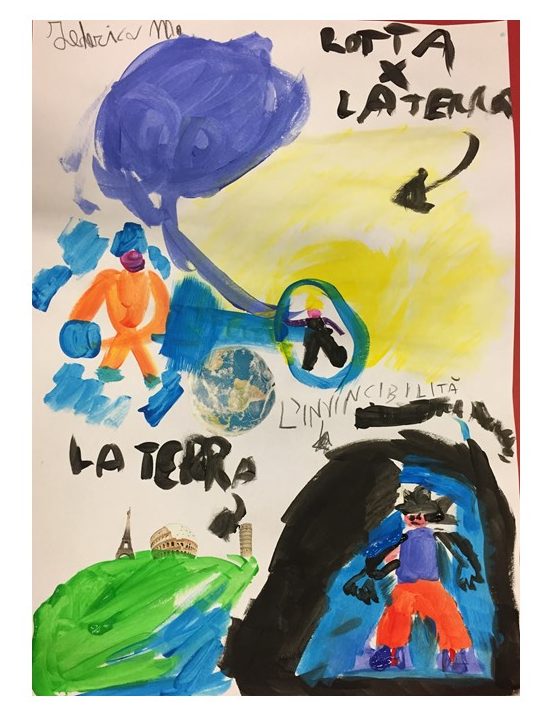
Picture b) Example of sign (curve arrows) describing a logical/spatial movement and a narration.
In Italian in text (form top to middle to bottom) To the Heart → The Heart → Invincibility
Mixed media: collage, pencil and tempera colours on paper (30x21 cm)
Author: F, 10 years old.
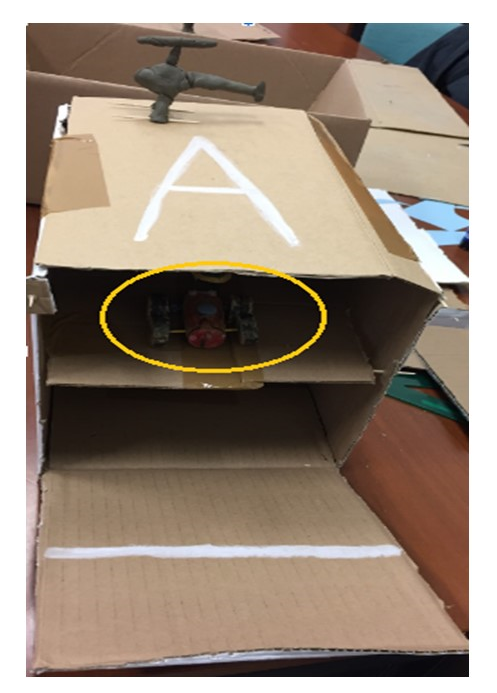
Picture c) Example of sign (line) outlining spaces having a logical meaning, functional to the designed project.
Note the ‘A’ letter and its function as helicopter landing place, as well as its narrative function as signature. The white line shows the contact point between vertical wall (open in the image) and the car machine inside the box.
Oil colors on cardboard box (30x30x40 cm)
Author: A., 8 years old
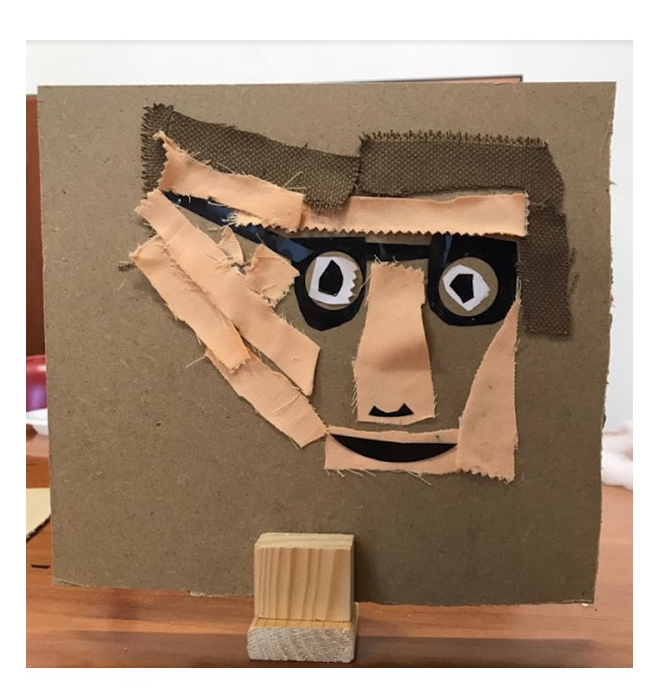
Picture d) Example of a self-portrait, describing the 3d and time dimension of the author’s face. Title “The Cubity”.
Mixed media: fabric and plastic assemblage on a wood panel (40x40x0,5 cm)
Verticalization by self-made wood plinth.
Author: F., 10 years old